Category: Newsletters

August 2018: Retirement Annuities

With the opening of the 2018 tax season, we have had many requests from clients on ways to minimise their tax liability.  One of the most efficient tax savings products to make use of is a retirement annuity. In the coming months we will be unpacking all the benefits of investing in:

 Retirement Annuities

A retirement annuity (RA) is an investment product which allows the investor to contribute lump-sum or regular monthly amounts into an investment to provide the investor with an income in retirement.

The benefits of investing in an RA is that contributions are tax deductible but limited to 27.5% of the greater of remuneration or taxable income capped at an annual limit of R350, 000. No interest or dividend withholding tax is payable within an RA. RA’s also provide protection from creditors.

Funds in an RA may not be accessed before the investor turns 55 years old. Upon retiring from the Fund investors have the following options available to them:

  • Purchase a compulsory annuity with the entire benefit to provide a regular income in retirement.
  • A maximum 1/3rd of the benefit may be taken as a cash benefit and the remaining 2/3rd’s of the benefit must be used to purchase an annuity to provide the investor with an income in retirement.
  • If the benefit is less than R247, 500 the entire benefit can be accessed as a cash benefit.

When an investor retires he or she is taxed according to the retirement tax tables:

0 – R500, 000 Tax-free
R500, 001 – R700, 000 18% of the amount over R500, 000
R700, 001 – R1, 050, 000 R36, 000 + 27% of the amount over R700, 000
R1, 050, 001 + R130, 500 + 36% of the amount over R1, 050, 000

In the example, Investor A contributes nothing to their RA, Investor B contributes 15% and Investor C makes the full 27.5% contribution to their RA. Not only is Investor C contributing to their future savings they are also able to reduce their tax liability by R33, 307.

Investor A Investor B Investor C
Taxable Income R400, 000 R400, 000 R400, 000
RA contributions R0 R60, 000 R110, 000
Tax per Scale R93, 039 R74, 439 R59, 732
Tax saving R0 R18, 600 R33, 307

In next month’s newsletter, we will discuss the practical application of retirement annuities in Financial Planning.

Fund of the month:  Allan Gray Balanced Fund

 The Fund of this month is Allan Gray Balanced Fund. This is a multi-asset high equity fund which attempts to create long-term wealth for its investors. The Allan Gray Balanced Fund has a proven long-term track record and has delivered investors with a return (net of fees) of 16.9% since its inception in 1999.

“Someone is sitting in the shade today because someone planted a tree a long time ago.” Warren Buffett

July 2018: Tour De France and the case for investing offshore

Wow, Le Tour de France never fails to delight!

The cycling is a wonderful test of athletic endurance.  Wow, isn’t the scenery beautiful?  Le Tour takes the viewer on a spectacular journey as the route meanders through the most beautiful villages, passed quaint medieval churches, along mountain roads, farms and valleys.  It is simply a magnificent sight!

Those of you who are watching, glued to your television sets, may have noticed that Marriott Income Specialists are sponsoring the television rights in South Africa. They are advertising a very attractive offshore product!

The Marriott First World Hybrid Real Estate Fund is a real estate investment company that invests in a combination of direct real estate and listed real estate investment trusts. The objective of this Fund is to combine the benefits of direct and listed First World real estate to generate a reliable, predictable and growing Sterling income. With the majority of the return generated from the income yield, the investment outcome can be anticipated with a reasonable degree of certainty.

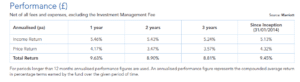
Here are the latest performance figures:

Marriott’s First World Hybrid Fund Returns

Drone footage of three key properties can be viewed via this link First World Hybrid Property video. The properties featured in this footage are:

  • Crown Packaging Manufacturing – Leicester
  • Keepmoat – Lakeside, Doncaster
  • Wickes – Grimsby, East Lincolnshire

When is the right time to invest offshore?

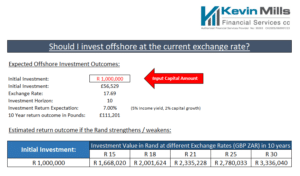
The spreadsheet attached allows investors to input their capital available and to see how the strengthening or weakening of the currency will affect their investment. Over the past 10 years the South African Rand has depreciated against Sterling on average by 2% per year. Were this to continue over the next 10 years then £1 British pound would cost a South African investor more than R21.

Expected investment returns

Give us a call to find out how you can invest into this attractive real estate fund and earn a Sterling-based income!

“Do not save what is left after spending, spend what is left after saving.” Warren Buffett

June 2018: Market update and need for Critical illness cover

Half year market update

Despite all the doom and gloom in 2017, the JSE ALSI returned 20.95% last year. Heading into 2018 there was a sense of excitement with every South African feeling a sense of “Ramaphoria”. Sadly the rally around this new found sense of optimism has seemed to run out of steam. As at the 31st of May the JSE ALSI had declined by 4.4% giving back a large part of the gains from last year. Along with the drop in the market we have also seen the rather rapid decline in the value of the rand going from almost R12 to the dollar to now almost R14.

The South African market is heavily influenced by world events and all the uncertainty regarding Trade Wars has negatively affected the domestic market. Over the past three years we have been positioning our clients’ funds into more conservative portfolios. These more conservative funds have been far less volatile than that of the market and have given investors a return of between 7 – 10% over the last year. It is very hard to predict what the future; or Donald Trump has in store for us and so we remain of the view that investors should remain cautious in the current investment climate.

Please contact us should you wish to arrange a meeting to discuss your portfolio and its positioning. We will be happy to discuss this over a cup of coffee.

When should you consider Critical illness cover?

Critical illness cover offers you financial protection should you be diagnosed with or require treatment for an illness which is deemed ‘critical’. On average 80% of all claims are from the four major critical illnesses; heart attacks, strokes, coronary artery by-pass graft and cancer.

The benefits of having Critical illness cover in place are that it allows the insured to be able to fund one or more of the following:

  • Pay for the costs of medical care and treatment
  • Replace any lost income due to a decreasing ability to earn
  • Provide the insured with enough funds to cater for a change in lifestyle

Clients often forego Critical illness cover owing to the price of this cover compared with life insurance or disability insurance. However statistics show that a male under the age of 25 who is a non-smoker has a 24% chance of getting cancer, having a stroke or a heart attack before he reaches the age of 65. 34% of all critical illness claims made by males occur before the age of 55.

With the advancement of medical technology, more and more people are fully recovering from these critical illnesses, however the medical bills associated with these illnesses are not always covered by your medical aid. With this in mind it is important to consider how your life would be impacted should you or a loved one be diagnosed with a critical illness?

Fund of the month: Investec Diversified Income Fund

The Fund of this month is the Investec Diversified Income Fund. This is an income generating fund that is suitable for investors whose primary focus is on receiving an income but also looking to maximise capital. This Fund returned 9.5% over the last year and a return of 8.8% over the previous three years.

The link below provides a quick description and investment philosophy of the Fund.

Investec Diversified Income Fund Philosophy

“The question isn’t at what age I want to retire, it’s at what income. “ George Foreman